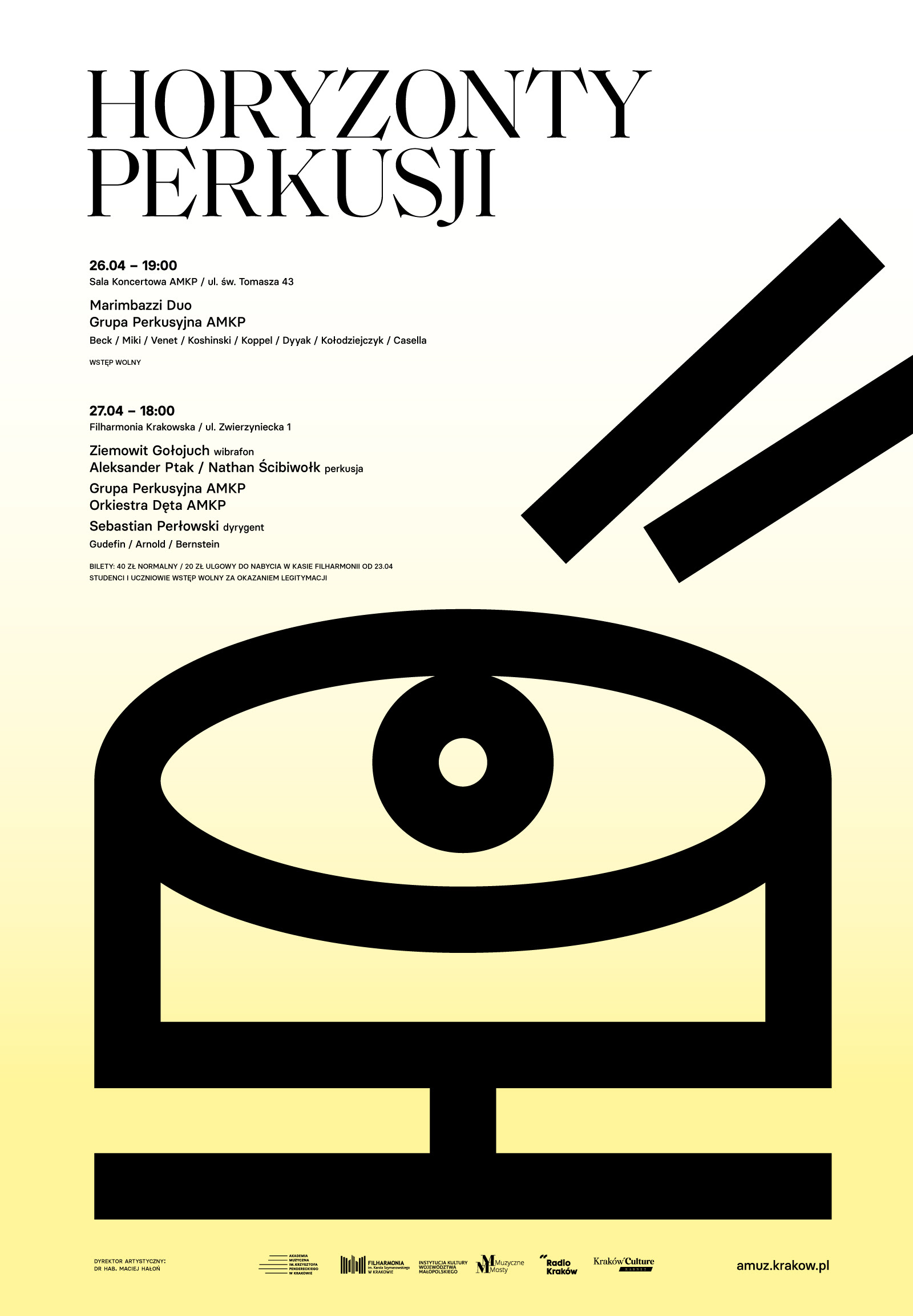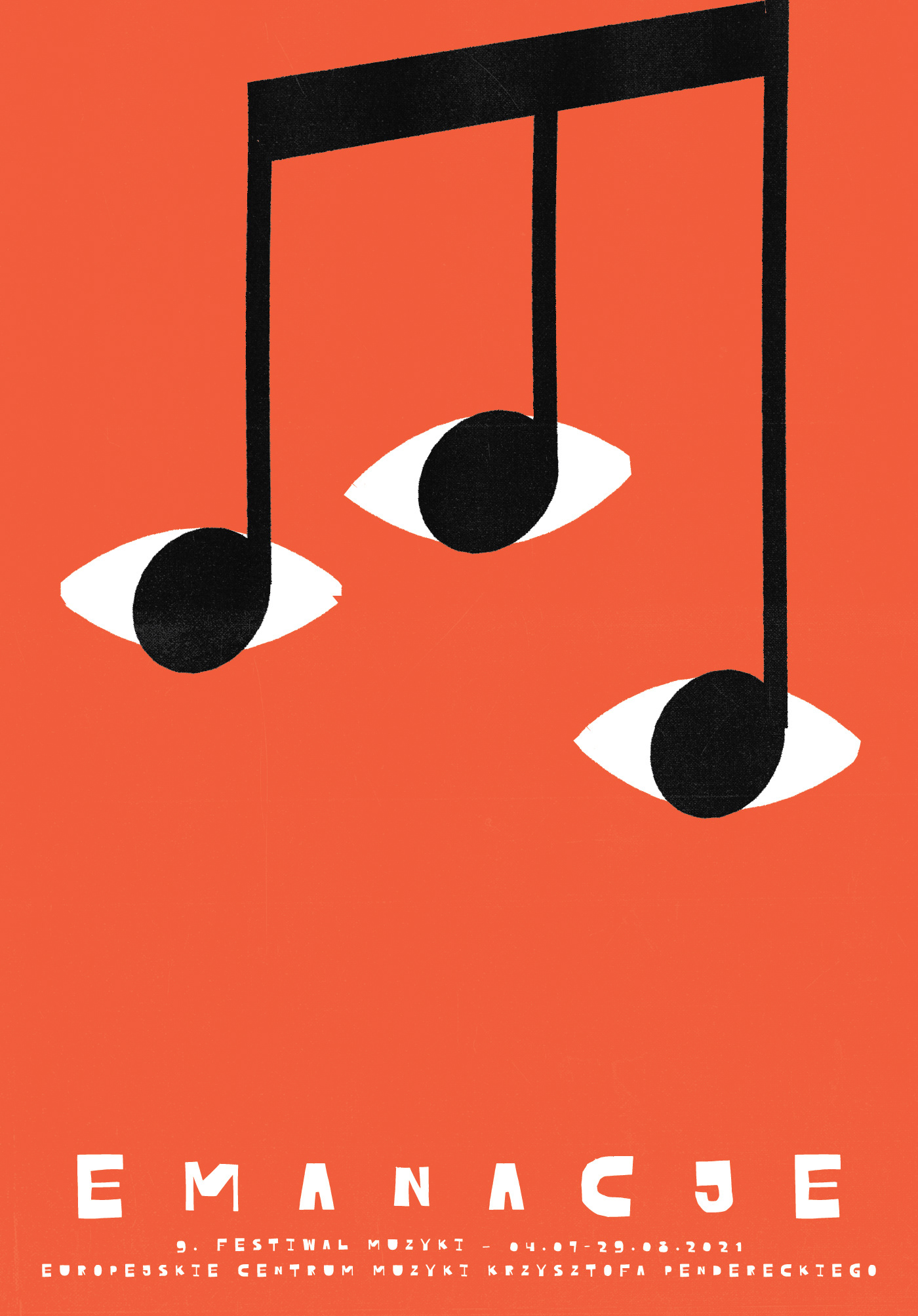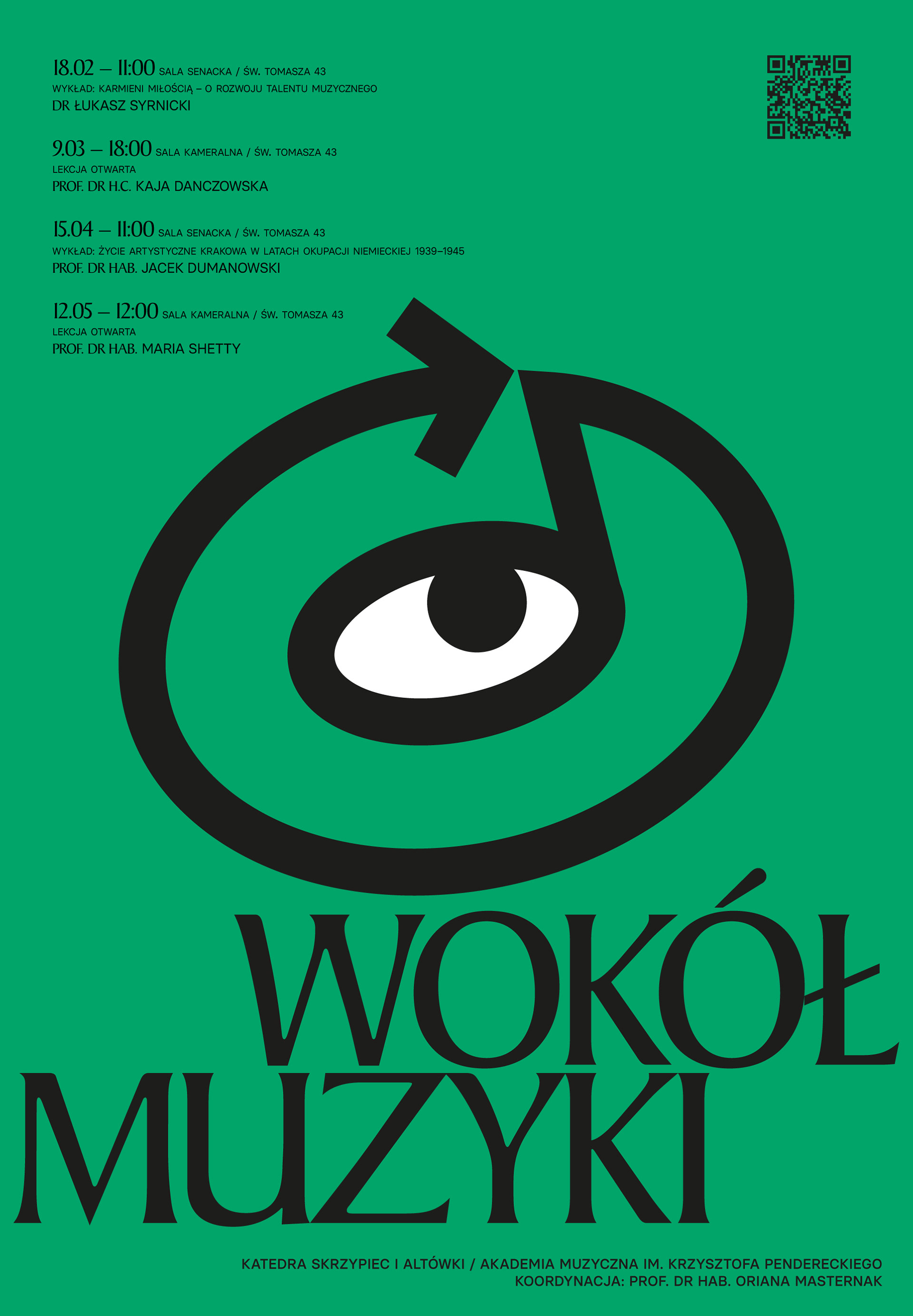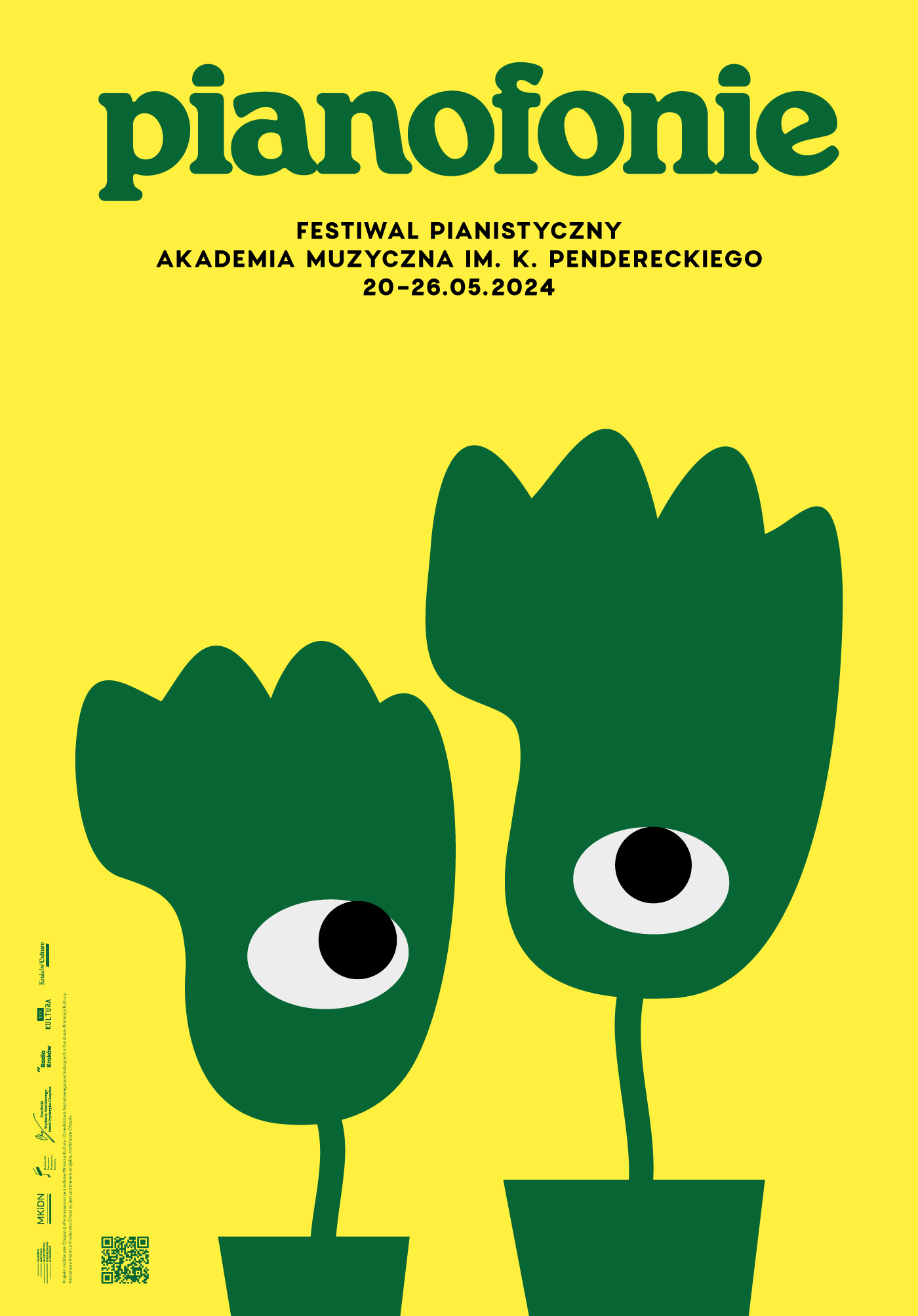
The eye in these posters is a sign of perception — it directs the viewer’s attention and organizes the structure of the image.
The eye is one of the most immediate and primal visual signs. It requires no interpretation. Before the viewer reads a title or registers a date, the eye in the image has already established contact. In these works, it appears as a sign of focused attention — the suspended moment before music begins.
The Eye as a Structural Element
In poster design, the eye rarely functions as a realistic representation. Reduced to its essential graphic structure — an ellipse and a circle — it becomes a compositional anchor. It carries visual weight and organizes the image around itself.
In Dzień Otwarty and Horyzonty Perkusji, the eye is embedded within a musical context — staff lines, a cymbal — without literally illustrating either. The forms merge into a single image that is at once musical and perceptual. Atmosphere is established before content is read.
In Zygmunt 1521–2021, the eye appears beneath the bell as its hidden center. The bell rings — the eye opens. Sound and perception become the same gesture.
The Eye as a Recurring Motif
In Emanacje and Wokół Muzyki, the eye is not a single focal point but a repeated element, distributed across the composition like a rhythmic figure in a score. Repetition creates continuity between projects while allowing each poster to remain autonomous.
In Pianofonie, the eye appears within an organic, almost botanical form. Here it loses symbolic gravity and becomes something lighter — curiosity rather than concentration. With that shift, the emotional register of the image changes entirely.
The Eye in Relation to Music
In Pasja wg św. Łukasza, the eye appears within the face of an animal — ancient, watchful, present. It carries no elegance here. It carries weight.
Music is an experience without fixed visual form. It exists in time, in the listener’s perception. A concert poster must therefore create an image for something that cannot be seen. The eye becomes a natural response to this challenge — not a representation of music, but of the act of listening itself.
A recurring visual motif is not a signature. It is a question asked consistently across different contexts — and answered differently each time.